
Documentation is an integral part of all workflows. The healthcare industry is no exception. It is and has always been rooted in medical services. However, I can’t be the only one seeing that clinical documentation has probably become the biggest burden for medical professionals. More patients, more work, more paper hassle. According to the recent research by JAMA Network Open, medical experts spend 1-2 hours on documentation for every 1 hour of patient care. Surprising right? And imagine that notes are getting longer, systems are becoming more complex, and patients are getting less and less time. Is this a change for the better? I don’t think so. Nevertheless, it isn’t a dead-end story. Let me elaborate on that.
As mentioned earlier, doctors, nurses, and other healthcare workers are drowning in documentation and EHR backlogs. Unfortunately, it might also cause burnout. With the rising needs and expectations, all the data must be accurate. I won’t exaggerate when I say that one simple mistake or missing detail can lead to audits, denials, or safety risks. Here’s good news! AI has already entered the picture. AI documentation tools for healthcare are not just an automation layer for existing systems, nor are they a replacement for clinicians.
As of 2026, I can surely say that AI in healthcare documentation is becoming a real workflow partner. And I don’t mean just transcribing or auto-filling. Modern AI medical scribe solutions can listen, suggest, summarize, detect, flag, and adapt, offering a significant clinical documentation improvement. In general, medical professionals are more focused and provide better care. If you are ready, I’d like to take you on a journey discovering how AI can benefit healthcare, what to consider, and which trends to expect. Ready? Let’s explore!

Why Clinical Documentation Needs Reinvention
In my humble opinion, everyone involved in the healthcare industry understands the need for clinical documentation automation. Nevertheless, 2026 is the year when it’s not just about automation but rather about automation reinvention. There have been plenty of solutions that, unfortunately, don’t fully unburden clinicians from the paperwork, notes, and records. That is why this system requires some level of reinvention. You might ask why? Let’s tackle this.
If you ask any clinician what slows them down, I bet documentation will be really high on the list (most of whom I know usually mention it at the very top, to be honest).
- Time spent on patient care vs. charting
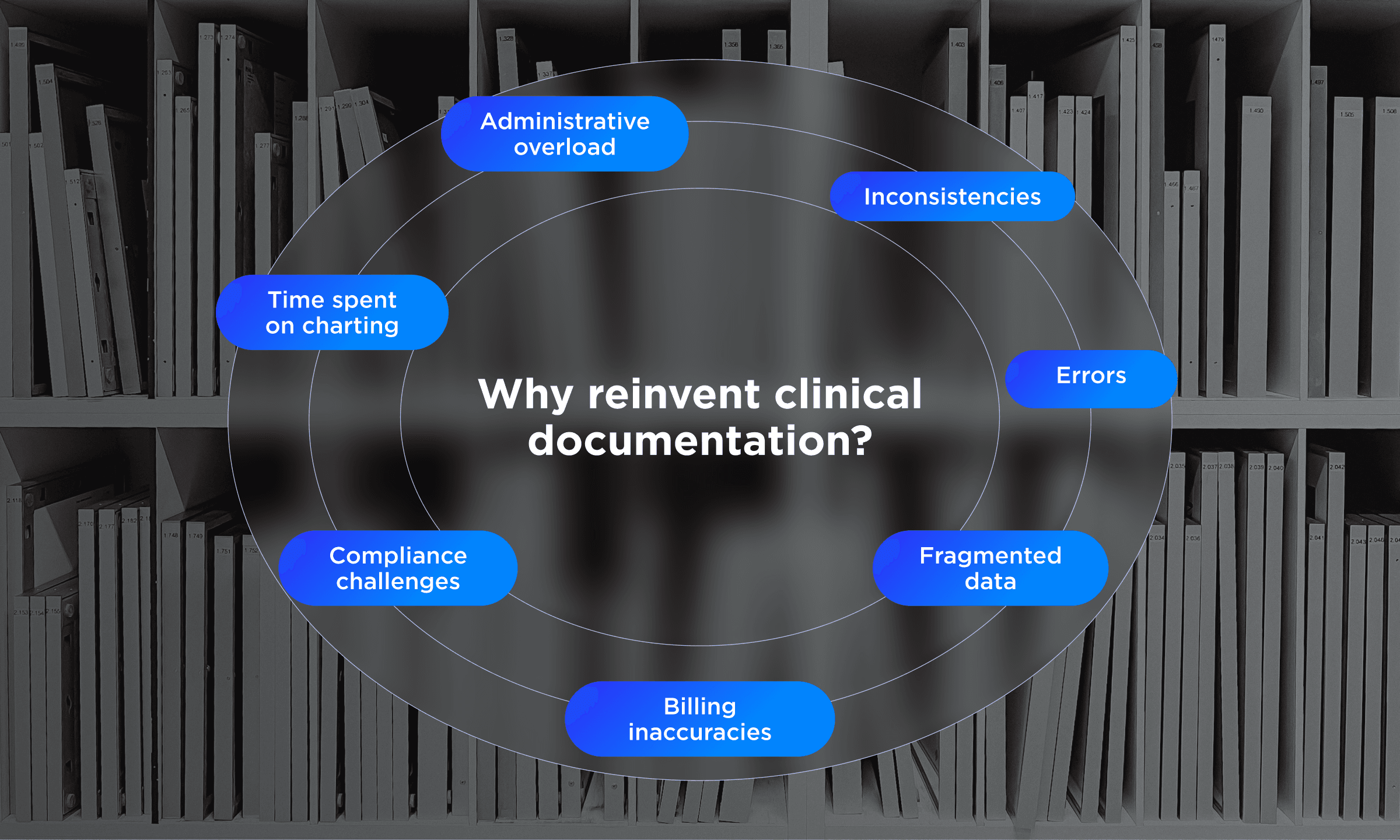
Unfortunately, it is common knowledge that clinicians sometimes spend more time charting they interacting with patients. Is it okay that documentation may take longer than the actual care? Of course, no. It is a never-ending hassle with discharge summaries, progress notes, referrals, authorizations, billing codes, etc. - Administrative overload leading to burnout
When speaking about administrative overload, it is not just annoying. Unfortunately, such overburden often causes burnout among medical professionals. And I am not surprised about that. Clinicians who become data clerks rather than caregivers often lose motivation. As a result, they aren’t so satisfied with their job and may burn out. Sorry to break it to you, but patient experience, which must come first, suffers too.
Healthcare documentation does not need more forms to fill in. It needs smarter ways to fill and process data.
Errors, inconsistencies, and compliance challenges
I hope you understand that manual documentation creates a lot of risks. However, another challenge is using various systems for different purposes.
- Fragmented data
As I’ve already mentioned, clinical data is often stored across systems. Some data and information are copied and pasted, updates get missed, and context disappears. Even small inconsistencies because of such fragmented data might cause big problems. - Impact on patient outcomes.
The most important thing to remember is that everything influences patients. All inaccuracies, unclear notes, or incomplete records pose risks of duplicated tests, for example, or miscommunication, or even medical errors.
Key AI Technologies Transforming Clinical Documentation
When I talk about top-tier AI medical documentation, I don’t mean one breakthrough technology. There is a stack of technologies that work together and make documentation automation smooth. Let’s explore the key AI technologies in healthcare.
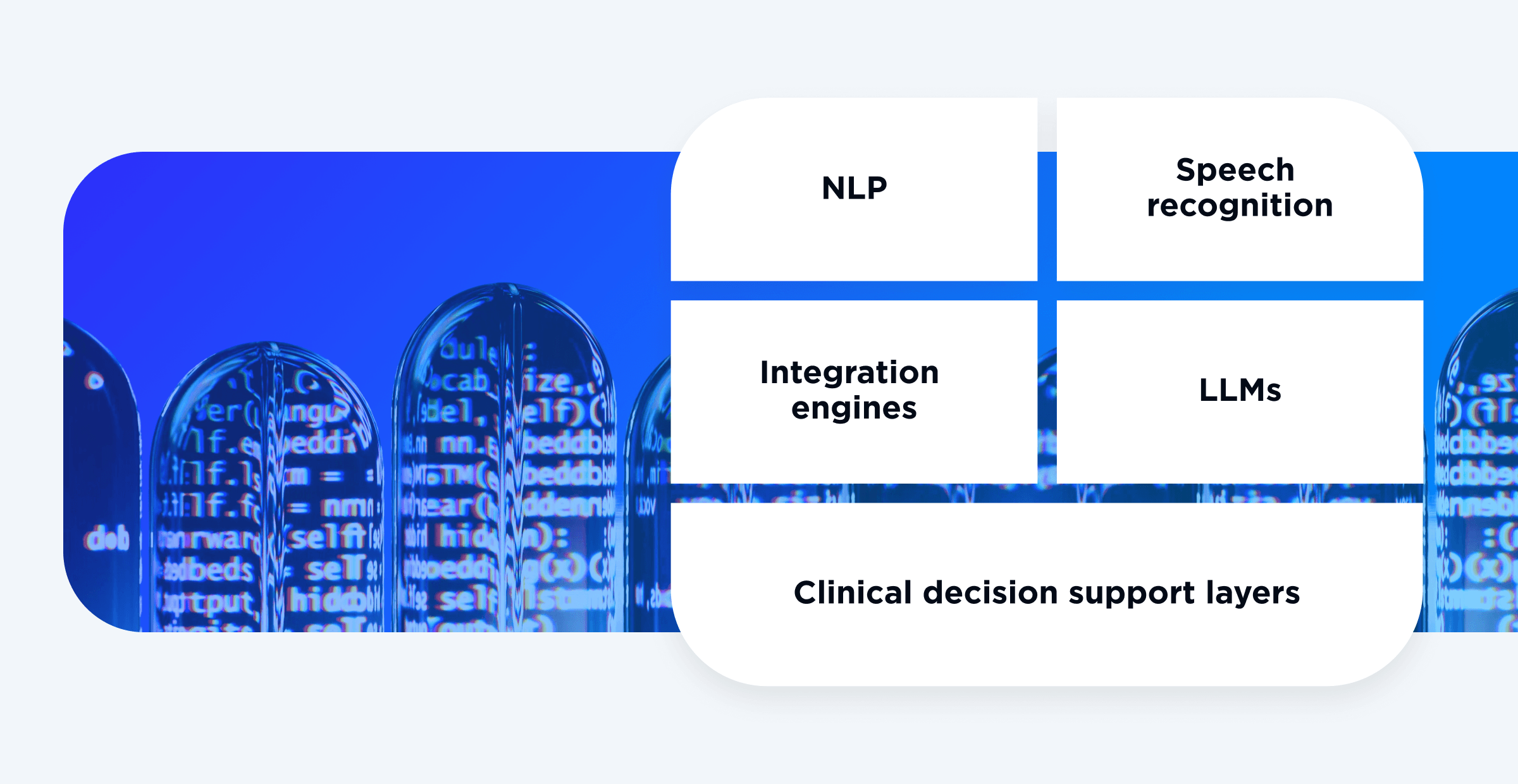
- Natural Language Processing (NLP)
NLP is the foundation of all systems. It allows them to understand clinical language. It also includes abbreviations, fragmented speech, context, negations, and specialty-specific terminology. - Speech recognition
This technology has boosted basic dictation. It helps recognize patient-clinician conversations, identify speakers, follow the flow, and detect clinical relevance. Moreover, it makes it natural. - Large Language Models (LLMs)
On top of that, large language models add contextual understanding to the systems. It enables analysis of the full clinical case, including symptoms, diagnoses, medications, and care plans. - Clinical decision support layers
For better healthcare workflow optimization, clinical decision support layers are essential in flagging missing elements, inconsistencies, or compliance risks. As a result, clinicians can correct issues in real time. - Integration engines
Integration engines are crucial as they connect AI tools with existing EHRs, billing systems. and analytics platforms following healthcare standards (such as FHIR and HL7). This way, AI fits perfectly into established workflows.
To wrap it up, I can say that these key technologies turn AI into a real workflow partner. All clinicians remain in control while receiving substantial support from smart solutions.
Benefits of AI-Driven Documentation for Healthcare Teams
Now that you know the reasons to implement AI-powered clinical workflows and technologies that make it happen, let’s explore the real benefits it brings.
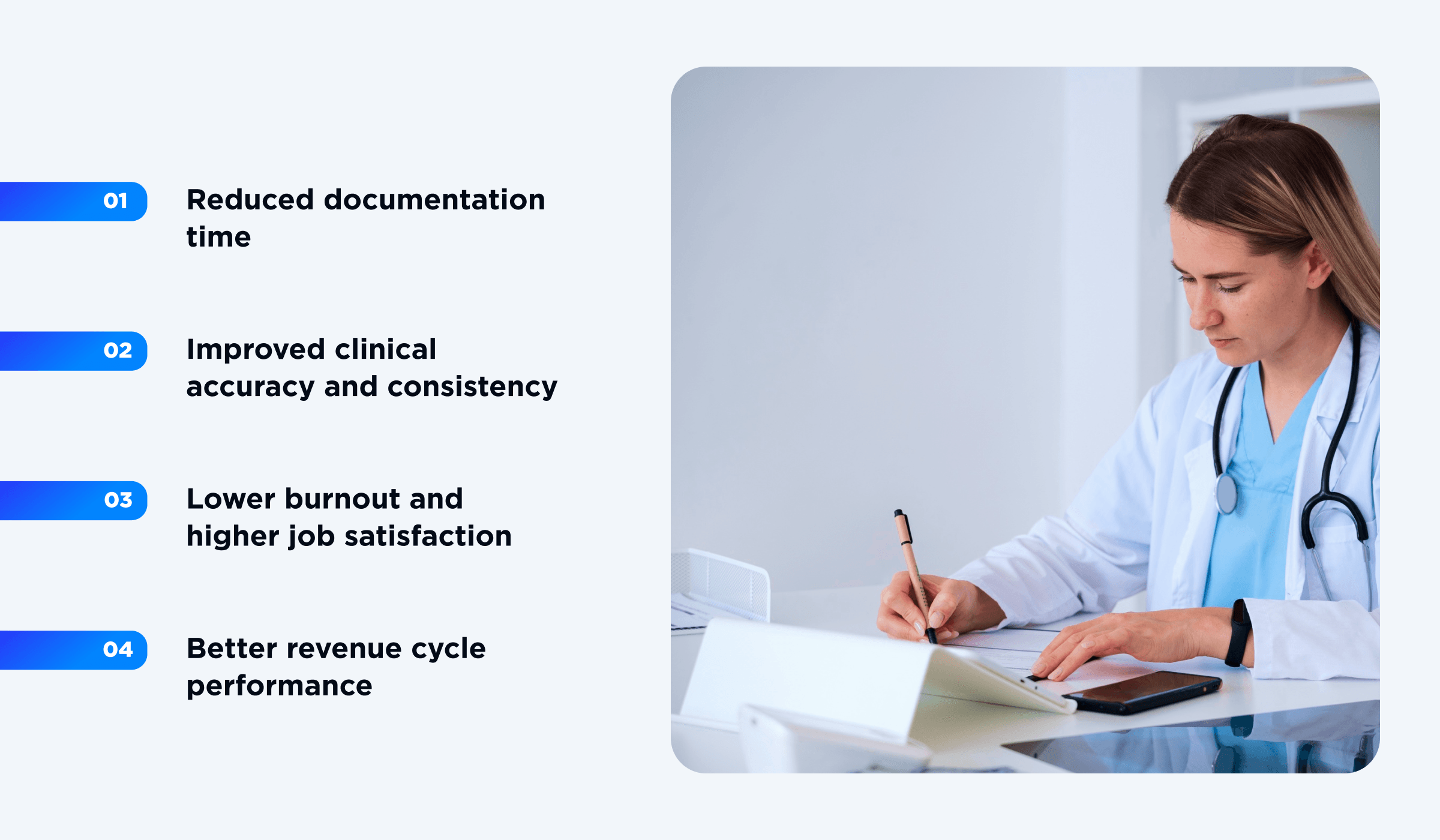
- Reduced documentation time
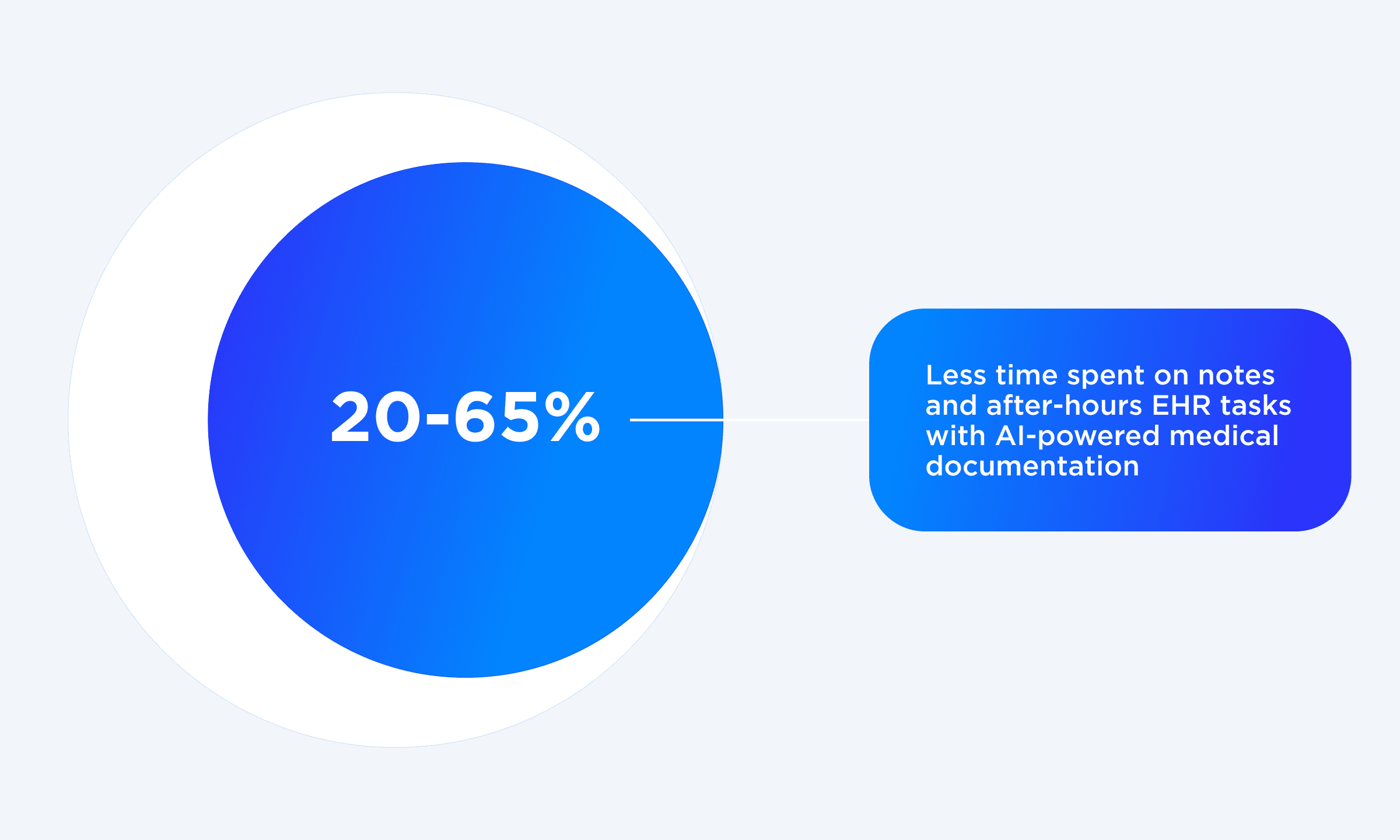
I should say this benefit is the most visible and immediate. It eliminates the need for manual copying, typing, and after-hours charting. Clinicians can generate notes much faster, make immediate updates (right after the visit), and receive more hours for meaningful work, that is, time for patients (or just a chance to have a break). - Improved clinical accuracy and consistency
AI in healthcare documentation is very good at recognizing patterns. What does it mean? If there’s any missing information or contradictions, it notices this immediately and flags if needed. As a result, the notes are more complete and consistent, and variability decreases. While AI suggests, clinicians still stay in charge. - Lower burnout and higher job satisfaction
As I’ve already mentioned, documentation overload may lead to burnout. With AI clinical documentation, clinicians receive the support they need. They can plan their work days, reduce (or even eliminate) after-hours charting, and feel more motivated. It contributes to team stability and overall morale. - Better revenue cycle performance
It is one of the most important benefits of AI medical documentation. Such accurate documentation enables full capture of clinical complexity. When everything is properly tracked (procedures, diagnoses, history, etc.), healthcare institutions get rid of financial pressure caused by claim denials. Altogether, medical organizations have much better revenue cycles.

Transform your workflows with OTAKOYI AI-driven solutions.
CONTACT USReal-World Use Cases and Emerging Trends
As I’ve introduced you to the benefits of AI clinical documentation automation, let me present some real-world use cases and emerging trends.
- AI-enhanced patient encounters
Patient visits go smoothly while AI quietly operates in the background. A clinician keeps the conversation going with a patient, while AI systems capture all the key details for documentation. It contributes to much better patient care without disrupting the conversation. For example, DeepScribe is a tool that captures patient visits and generates well-structured clinical notes in real time. - AI-driven clinical summaries
Clinicians spend long hours drafting summaries. Nowadays, AI can generate summary drafts that accurately reflect everything from a patient’s visit. Clinicians can still review, edit, and approve those summaries. However, it takes them minutes rather than hours. Take a look at Abridge – a solution that creates clinical summaries and notes from real clinician-patient conversations. - Virtual scribes
This is a mainstream technology in 2026. They help reduce cognitive load on medical professionals. AI scribes can easily integrate with EHR workflows and scale on demand. It significantly simplifies work without replacing human judgment. For example, Heidi Health is an AI-driven scribe that transcribes consultations into clinical notes and patient histories. - Predictive clinical documentation
It is a breakthrough for medical organizations. Modern AI systems can even anticipate what documentation may be needed next. They analyze patient history and clinical context and prepare templates, prompts, and reminders. It happens even before the clinician asks for it. Check out AthenaOne – a platform that gives predictive suggestions and documentation prompts relying on clinical context and data within the EHR.
One more distinct real-world case is our OTAKOYI AI assistant for the tumor board. What does it do?
- Instantly captures real-time discussions.
- Converts discussions into structured summaries.
- Makes sure all notes follow security and compliance standards.
- Reduces documentation time by 60%.
- Collaborates with team discussions and workflows seamlessly.
Challenges and Ethical Considerations
Even though everything sounds easy enough, there are some things to take into account before you implement AI clinical workflows.
- Data privacy and security
We all know that clinical data is highly sensitive. Before implementation, you must make sure AI systems comply with strict security, privacy, and regulatory standards. It is also important to provide for encryption, access controls, and audit trails. - Accuracy and hallucination risk
Unfortunately, even AI systems can make mistakes. However, healthcare requires a high level of accuracy. To avoid that, remember to preserve human-in-the-loop validation. This way, you make clinicians verify the data and be accountable. - Workflow adaptation and staff training
You are aware that technology cannot fix workflows by itself. You require profound staff training and time for them to adapt. Make realistic expectations, provide clear explanations, and receive constant feedback from clinicians.
How Healthcare Organizations Can Prepare for AI-Enabled Documentation
So, what is the best way for a healthcare organization to prep for AI clinical workflows? Considering all the challenges and ethical considerations, as well as potential benefits, the plan is simple:
Step 1: Start with high-impact workflows
Remember that not every workflow requires AI immediately. Choose the areas with the highest documentation overload first.
Step 2: Choose AI tools that integrate with existing EHRs
Opt for AI in healthcare documentation that can easily integrate with your current systems. Don’t change everything overnight.
Step 3: Establish human-in-the-loop validation
As mentioned earlier, human oversight is essential. Keep human reviews and edits. Also, remember to establish clear ownership and accountability.
Step 4: Build a governance framework
It is a must. Clearly define policies and frameworks for model updates, data uses, and monitoring. Governance keeps everything safe.
The Next 5 Years: What AI Will Enable in Clinical Documentation
You might be wondering what we should expect in the future. Of course, current AI in healthcare documentation is not the “final tool” for us to implement. The table below highlights the trends most likely to shape the near future, and the ones I’d like to discuss.
- Fully ambient and hands-free documentation
This advancement means no keyboards, no constant clicking, and no dictation commands. While clinicians will be focused on patient care, documentation will be happening quietly in the background. - Personalized note generation by specialty
No more generic notes! AI will be able to adapt documentation to specialty, clinician preferences, and specific patient context. Notes from the ER physician won’t be the same as those from a follow-up visit. - Predictive insights (embedded directly in notes)
This important shift presents something like smart notes. No more static notes. Future tech will offer predictive insights. Documentation flow will include relevant history, risk indicators, and follow-up suggestions. - AI agents collaborating with clinicians in workflows
AI agents will become more proactive and collaborate across workflows. They will assist clinicians in documentation, triage, referrals, follow-ups, etc. It will reduce friction at every stage of care delivery.
As you can see, healthcare is expected to become more manageable. This industry is too complex to completely let go of the documentation burden. However, future AI clinical documentation will significantly change the way clinicians experience their work and provide patient care.
Final Words
I don’t want you to think that documentation is evil. It can be a breeze with the right approach to AI clinical documentation.
As you can see from this article, AI can be a dedicated and trusted workflow partner, providing clinicians with the support they need. 2026 urges medical organizations to embrace AI-driven solutions for optimized documentation and improved quality of services.
At OTAKOYI, this is our main goal - to help healthcare institutions and teams design, implement, and benefit from AI tools that fit real clinical workflows. Are you ready for the future where documentation works with you?