
2026 in the UK real estate industry began with the Building Safety Regulator issuing enforcement decisions. As of now the Accountable Person is personally liable. And the most common answer I hear from property managers about their compliance record is: "I'm confident about last month's buildings — the rest, I think we're fine."
That hesitation used to be acceptable. Now we are in the enforcement phase. The Building Safety Regulator (BSR) became a standalone body in 2025. The machinery is not theoretical anymore — it is issuing decisions, and the consequences are serious.
This article explains what the Golden Thread requirement actually demands in practical terms, where most property managers currently fall short, and what a compliant system looks like going into 2026.
What Changed and When
The Building Safety Act 2022 was the most significant reform to building safety regulation in a generation. But the legislation itself was not the turning point, the enforcement phase is.
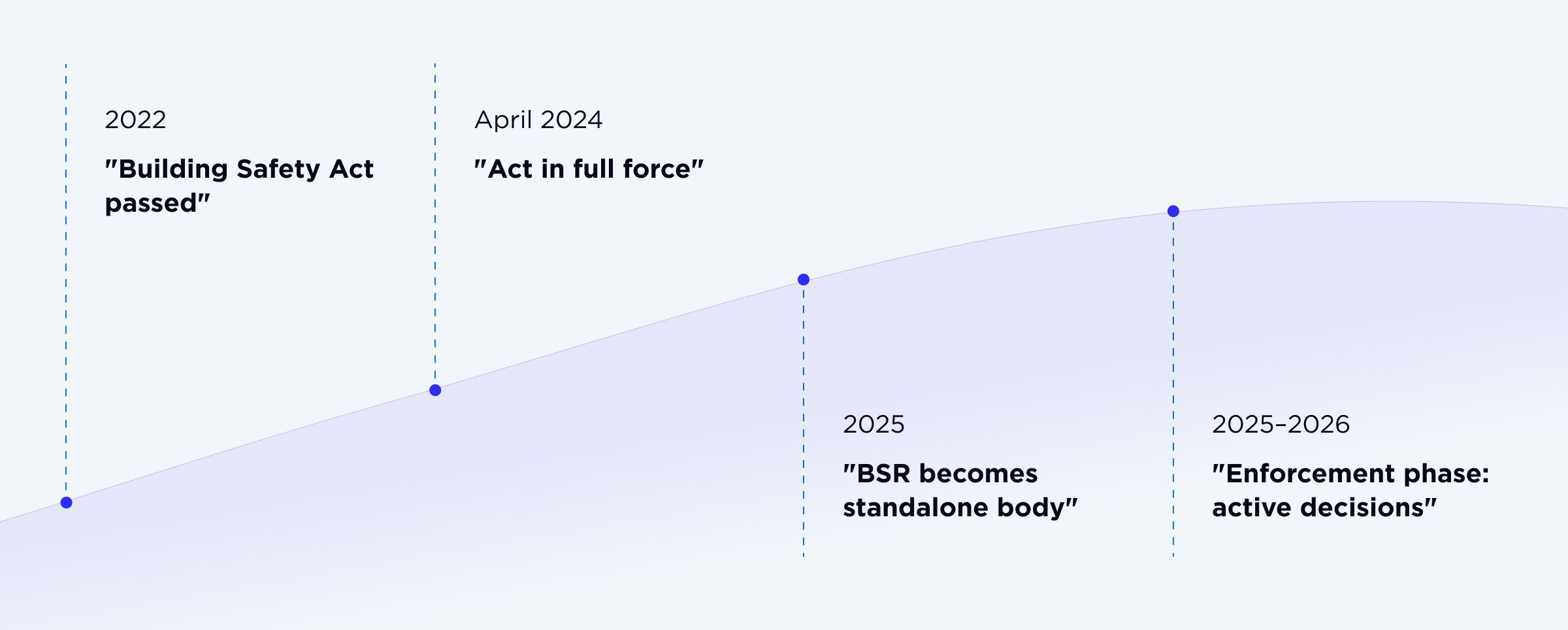
Here is the sequence that matters:
- 2022: The Building Safety Act receives Royal Assent. The framework is set.
- April 2024: The Act comes into full force. Accountable Person duties become live obligations, not future requirements.
- 2025: The BSR becomes a standalone regulatory body. It is no longer embedded in the Health and Safety Executive but operates independently with its own enforcement priorities.
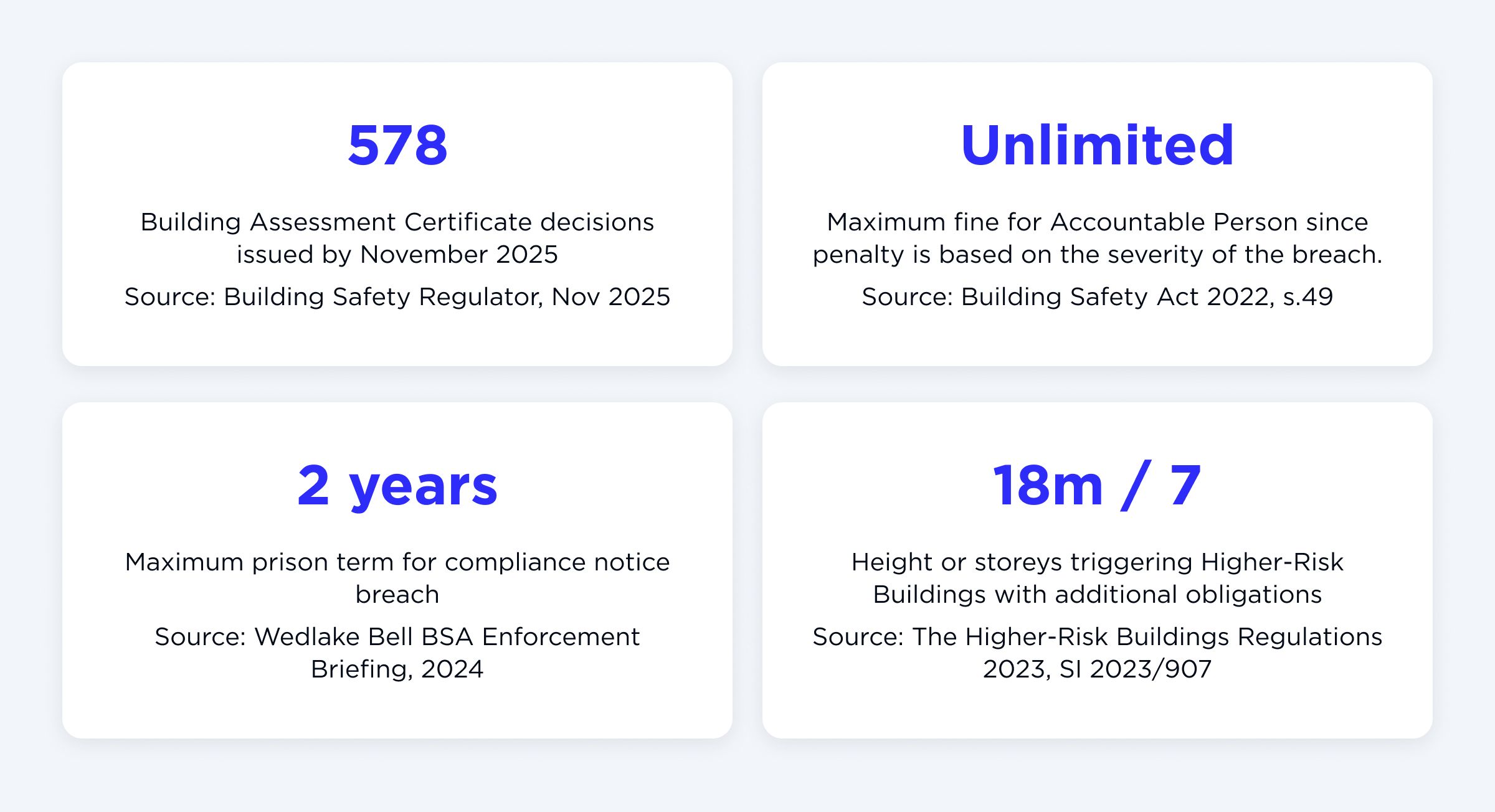
- 2025-2026: The enforcement phase is active. 578 Building Assessment Certificate decisions had already been issued by November 2025. The Remediation Acceleration Plan is in effect.
To conclude, the BSR is not a future threat to plan for. It is an active regulator issuing decisions right now, and property managers who are still in "we'll get to it" mode are already behind the curve.
The Accountable Person: What the Liability Actually Looks Like
The term "Accountable Person" (AP) appears throughout the legislation, and it is worth being precise about what it means in practice since property managers are often acting on behalf of the AP without fully understanding the personal exposure involved.
LEGAL NOTICE

Contravening a compliance notice without reasonable excuse is a criminal offence under the Building Safety Act. Penalties include unlimited fines and imprisonment of up to two years. Ignorance of the obligation is explicitly not a defence under the Act.
The AP holds a statutory duty to prevent building safety risks — specifically fire spread and structural failure. This duty applies regardless of whether the AP manages the building directly or delegates operational responsibility to a property manager.
In practical terms, this means:
- Property managers acting for the AP carry direct accountability for the evidence trail
- Delegation does not transfer the legal obligation, distributing the operational responsibility instead
- If the BSR finds a gap in safety management, the AP is the named individual facing consequences
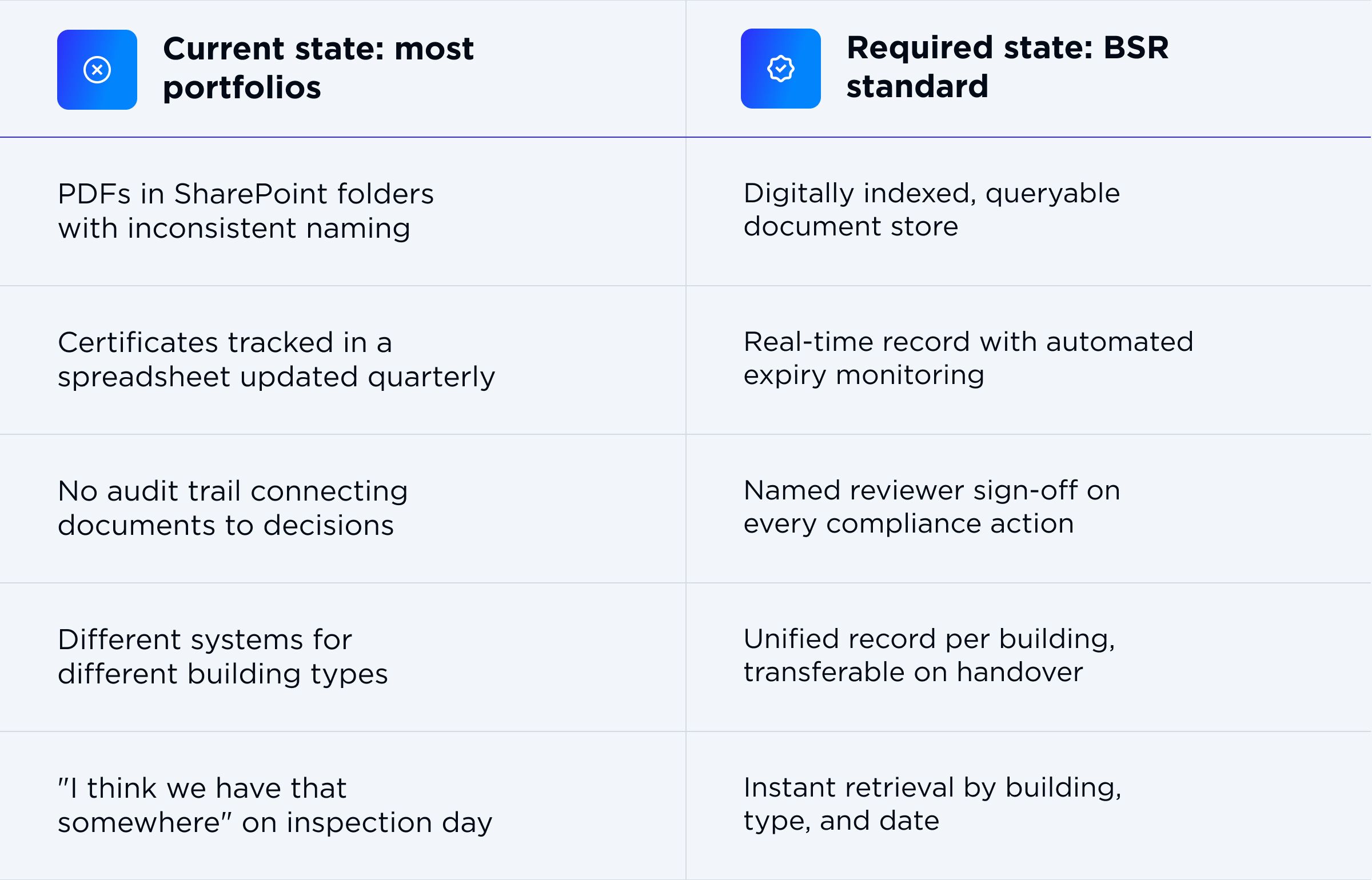
- "We had a spreadsheet that someone updated last quarter" is not a defence
"The move from "reactive maintenance" to "evidenced safety" is not gradual. The enforcement machinery is active now."
— BSR Transition Briefing, 2025
The Golden Thread — What It Actually Requires
"Golden Thread" is the regulatory term for the digital, continuously maintained record that building owners must keep for every higher-risk building. The concept sounds straightforward, but the operational reality is where most portfolios fall short.
The Golden Thread has four information layers that must be maintained:
| Information Layer | What Must Be Included | BSR Standard |
| Original Design Intentions | Structural drawings, fire strategy documents, architect specifications | Digitally searchable, transferable |
| Maintenance Records & Surveys | Structural survey history, O&M manuals, remediation records | Single source of truth per building |
| Statutory Compliance Certificates | Fire risk assessments, EICRs, gas safety, asbestos plans, lift inspections, legionella risk assessments | Current, source-cited, audit-ready |
| Real-Time Fire Safety Data | Active monitoring records, fire door inspections, detection system logs | Continuously updated, not point-in-time |
The BSR has been explicit about the technical standard: the data must be digitally searchable and transferable. It must represent a single, current source of truth — not a collection of folders, email threads, and spreadsheets that tell different stories depending on who last touched them.
The Compliance Certificates Requirement in Detail
Statutory compliance certificates are the most operationally demanding part of the Golden Thread for property managers running multi-site portfolios. The certificate categories that must be tracked include:
- Fire Risk Assessments (FRAs)
- Electrical Installation Condition Reports (EICRs)
- Gas safety certificates
- Asbestos management plans
- Lift inspection reports
- Legionella risk assessments
- Fire suppression system inspection records
90/60/30 AI ALERT SYSTEM

Most property managers only discover a lapsed certificate when someone checks the spreadsheet. By then, the certificate may already be expired, and the building may already be in violation. A compliant system surfaces expiry risk at 90, 60, and 30 days, with the source document attached to every alert. Your team reviews every alert and decides what happens next: the AI monitors, the human acts.
Transform your Real Estate workflows with AI-driven solutions
CONTACT USHigher-Risk Buildings and the Safety Case Report
For buildings that qualify as Higher-Risk Buildings (HRBs) — those over 18 metres or 7 storeys with at least two residential units — the obligations go significantly further.
In addition to maintaining the Golden Thread, the Principal Accountable Person (PAP) for an HRB must submit a Safety Case Report to the BSR. This report must demonstrate, with evidence, that the building is safe for continued occupation.
The consequences of an inadequate Safety Case Report are severe: the BSR can refuse to issue a Building Assessment Certificate. A building without a certificate is effectively unmanageable, and it cannot be registered, and occupation becomes legally compromised.
| HRB Threshold | Additional Obligation | Consequence of Non-Compliance |
| 18 metres or 7+ storeys with 2+ residential units | Submit Safety Case Report to BSR | Refused Building Assessment Certificate — building unmanageable |
| All HRBs | Register with BSR | Criminal offence for unregistered occupation |
| All HRBs | Appoint a Building Safety Manager | Enforcement notice, unlimited fine |
| All HRBs | Maintain and update Safety Case | BSR inspection, potential prohibition notice |
The 578 decisions already issued by November 2025 make one thing clear: the BSR is not holding back to allow portfolios time to catch up. The enforcement machinery is operational, and the volume of decisions will only increase as registration deadlines pass.
The Resident Engagement Requirement (Often Overlooked)
Most property managers focus their BSA preparation on certificates and documentation. The resident engagement requirement tends to receive less attention, which is a mistake, because it is equally statutory.
The Building Safety Act requires a formal Resident Engagement Strategy. In practice, this means:
- Residents must have access to building safety information — not just on request, but as a structured, available resource
- Residents must have a transparent, functioning channel to report safety concerns
- Reports made by residents must enter the property manager's compliance workflow
- The strategy must be documented and demonstrable to the BSR on inspection
WHAT THIS MEANS IN PRACTICE

A PDF emailed to residents once a year does not satisfy this requirement. The BSR expects a functioning engagement channel — a portal or structured communication layer where safety reporting is traceable, timestamped, and connected to action. This is not a tenant experience feature. It is a compliance requirement.
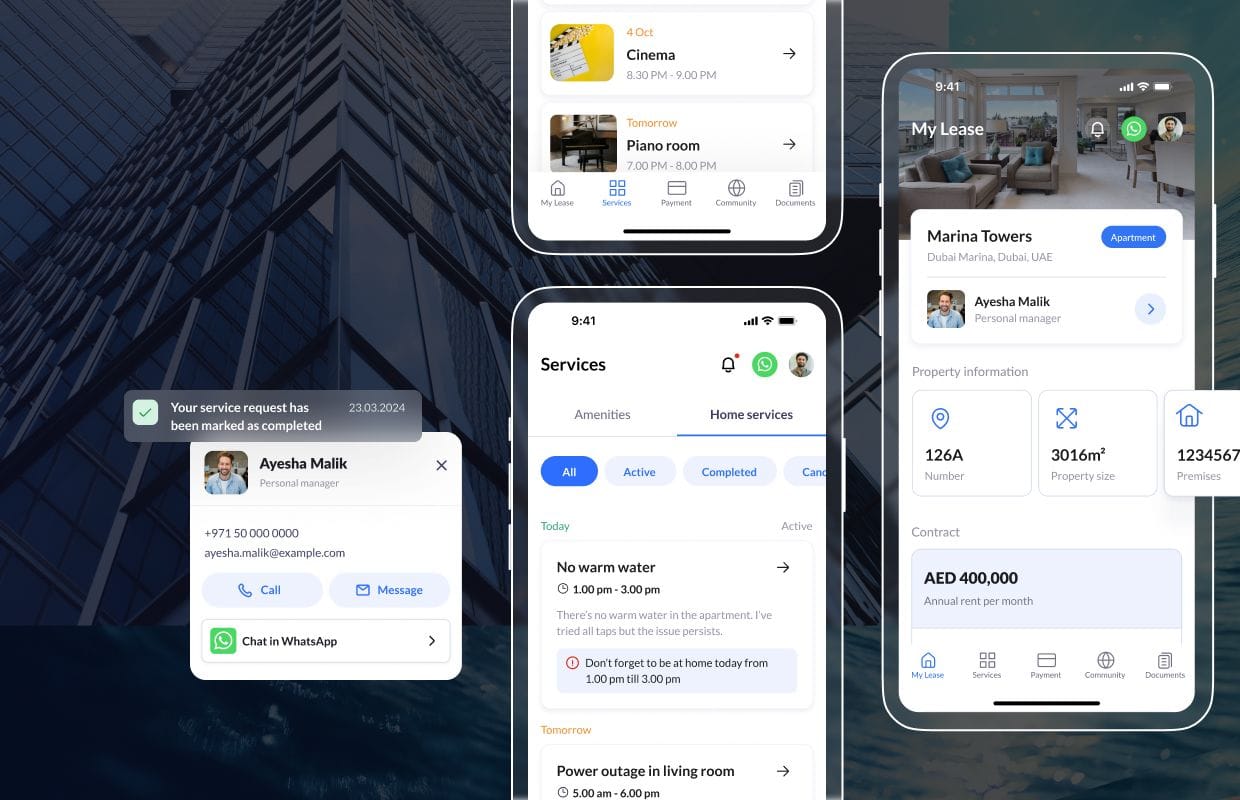
The good news is that a compliant resident engagement channel is also a better-run building. We know this from direct experience. For a luxury residential portfolio in the UAE, OTAKOYI built a custom property management platform — a mobile app for residents and a web dashboard for managers — that centralised all communication, service requests, and documentation in one place.
Tenants could report issues with photos attached, track the status of every request, and access their lease documents and building updates without calling anyone. Managers had a single operational view across the entire portfolio with full accountability at every step.
That platform was not built for BSA compliance — the UK legislation did not apply. But the architecture it delivered is precisely what the BSR's Resident Engagement Strategy requires: structured, traceable, timestamped communication between residents and the management team, connected to a workflow that actually resolves issues and creates a record of having done so.
For UK property operators building or upgrading a resident engagement channel, this is the right starting point. Instead of a generic portal bolted onto an existing PMS you get a system designed around how residents actually communicate and how managers actually operate.
What a Compliant System Looks Like in 2026
The question I get asked most often is: "What does the BSR actually expect to see when they inspect?" Having worked with property operators across portfolio types, I can summarise it this way: they expect evidence, not assurances.
A compliant system in 2026 has five operational characteristics:
| Characteristic | What It Looks Like | What It Replaces |
| Digitally searchable records | Any certificate, by building, type, or date — retrieved in seconds | Folder searches and email chains on inspection day |
| Proactive expiry monitoring | Alerts at 90, 60, and 30 days before expiry — with source document attached | Quarterly spreadsheet reviews that miss the gaps |
| Named reviewer audit trail | Every compliance action logged against a named person and timestamp | "Someone checked it" with no record of when or who |
| PMS integration | Compliance record connected to operational system (Yardi, MRI, Qube) | Separate compliance files disconnected from live operations |
| Resident engagement channel | Functioning portal with traceable safety reporting and response records | Ad-hoc email, phone calls, paper forms |
"The operators who pass BSR inspections without disruption don't have bigger compliance teams. They have better systems that make the evidence visible before the inspector arrives."
Where AI Document Intelligence Fits In
The most important thing to understand about AI in this context is what it is not doing.
- It is not making compliance decisions
- It is not determining whether a building is safe
- It is not replacing the qualified person who signs off on a fire risk assessment
What it is doing is solving the data problem that makes compliant management so operationally difficult at scale.
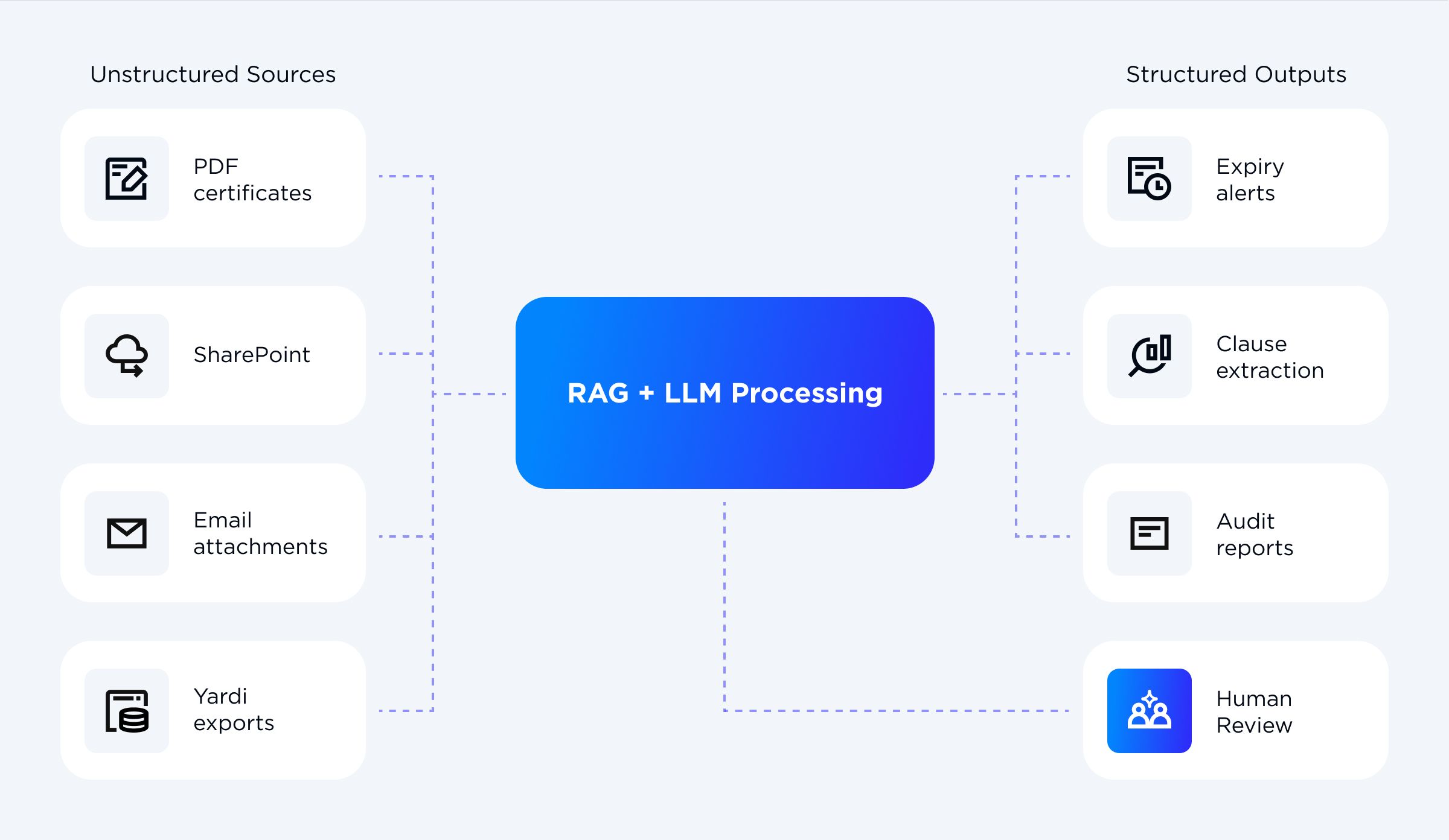
Here is how the architecture works in plain terms:
- Ingestion: Thousands of unstructured PDFs (certificates, O&M manuals, fire reports) are processed into a queryable knowledge base
- Extraction: Structured data is pulled from each document: property, certificate type, issue date, expiry date, certifying body, conditions
- Monitoring: The system tracks expiry windows and generates alerts at 90, 60, and 30 days, with the source document cited in every alert
- Query layer: Compliance managers can ask plain-English questions — "Which buildings have EICRs expiring in Q1?" or "Show me the fire risk assessment for Elm House" — and receive sourced, cited answers
- Human review gates: Every alert goes to a named reviewer. No automated procurement, no automated contractor dispatch. The AI surfaces the risk; your team decides the response
HUMAN-IN-THE-LOOP ARCHITECTURE

In a regulated market like UK property, "autonomous AI" is the wrong architecture. Every output in our compliance platform is reviewed by a named human before any action is taken. This is not a limitation but rather the design that makes the system defensible to the BSR and acceptable to your legal and compliance team.
The technical architecture is directly portable from our MedScribeAI platform — certificate ingestion maps to clinical document ingestion; expiry monitoring maps to regulatory audit trail logic; source-cited alerts map to the PHI redaction review workflow. The domain shifts from healthcare to property compliance, but the engineering pattern is the same.
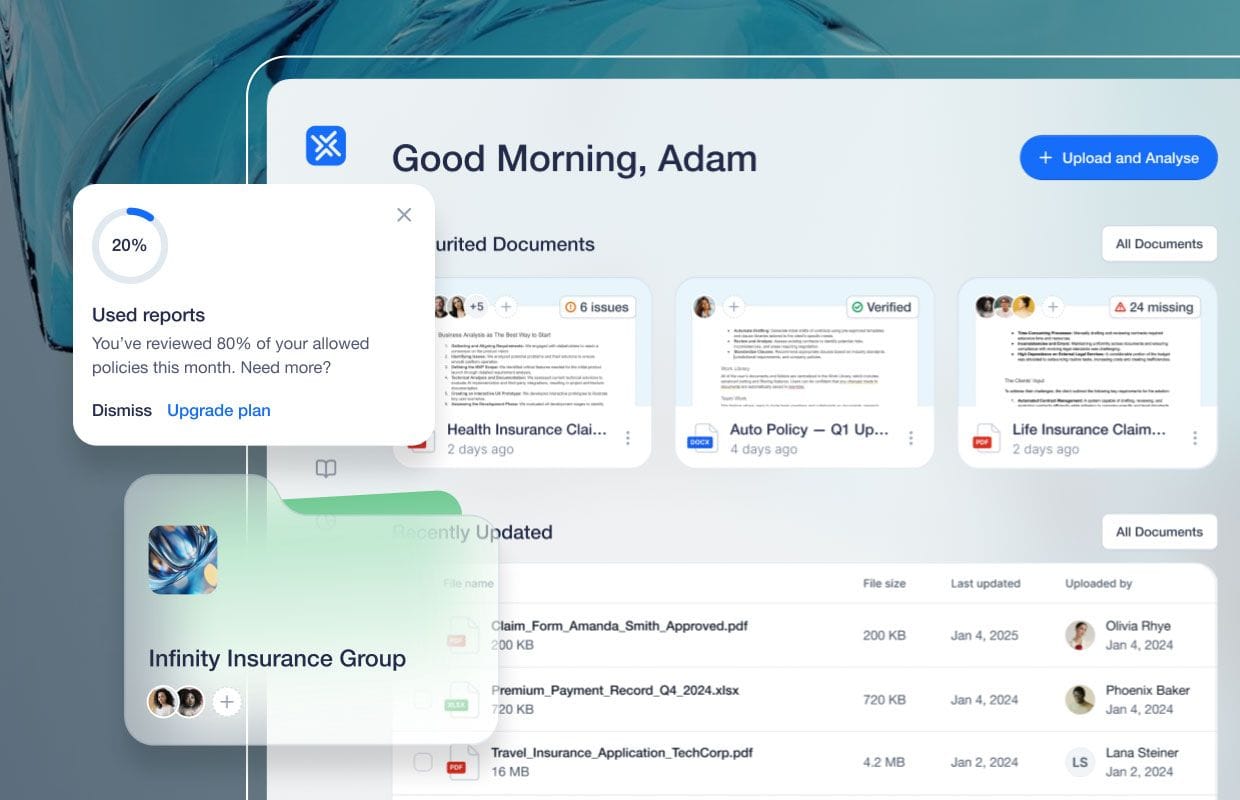
Legacy Systems and the Integration Reality
One concern I hear consistently from Operations Directors is: "We're already using Yardi / MRI / Qube and can't replace those." This concern is valid, but it is also based on a misunderstanding of what a compliant Golden Thread solution requires.
A compliance intelligence layer does not replace the PMS. It sits on top of it. The integration approach is an API layer that bridges the financial and operational data in Yardi or MRI with the compliance record that the BSR needs to see. The PMS continues running the business. The compliance layer makes the safety evidence audit-ready.
| PMS System | Integration Approach | What Stays, What's Added |
| Yardi | API layer connecting property and lease data to compliance record | Yardi stays as financial/operational core. Compliance intelligence runs alongside. |
| MRI / Qube | Data extraction pipeline reading property and tenancy data | Block management workflows unchanged. Compliance alerts added on top. |
| StarRez | Integration with student housing workflows and maintenance module | Existing ticketing preserved. Compliance monitoring layer added. |
| Custom / Legacy | Document ingestion direct from SharePoint, file store, or email archive | No rip-and-replace. Existing data sources are the input. |
The critical phrase here is "rip-and-replace." Every COO and Head of Operations I've spoken to in UK property has the same fear: a technology project that disrupts live operations to deliver a compliance benefit. The phased approach with audit first, implement second, maintain third, exists precisely to avoid that outcome.
How to Start: The Compliance Coverage Audit
The most common mistake property managers make with BSA compliance is treating it as a large technology project that requires executive approval before anything can move. It does not have to start that way.
The practical first step is a structured compliance audit: a three-week assessment that maps your current obligations, identifies gaps, and quantifies your exposure before the regulator does it for you.
| Audit Stage | What It Covers | Output |
| Week 1 | Full inventory of statutory compliance obligations across the estate | Obligation register by building type and certificate category |
| Week 2 | Gap analysis — lapsed, missing, or expiring certificates within 90 days | Risk-tiered report with enforcement exposure quantified |
| Week 3 | Implementation roadmap and ROI model | Cost-of-inaction vs. platform cost analysis; phased delivery plan |
Most buyers discover their compliance gaps during this audit. Not because they were negligent, but because manual tracking across 50+ sites on spreadsheets creates blind spots that are invisible until someone maps them systematically. Seeing the exposure in writing, with the regulatory consequence named, makes the implementation decision straightforward.
"A property manager who won't invest in understanding their compliance exposure today will spend significantly more managing an enforcement notice tomorrow."
Final Word
The BSR transition is a change that has already happened. The question for property managers in 2026 is no longer whether to take the Golden Thread requirement seriously — it is how quickly you can build a system that meets the standard.
The operators who manage this well are not the ones with the largest compliance teams. They are the ones who stopped relying on spreadsheets and built evidence layers that work at portfolio scale. They can answer the inspector's questions in seconds, not hours. And they are not waiting for the next enforcement notice to find out where their gaps are.
If you are managing 20 or more assets and your current compliance record lives primarily in spreadsheets and PDF folders, that is the honest starting point. Our team begins with an audit to surface exactly where your exposure lies, then resolves it through practical property management and AI solutions built for the way real compliance teams work.