
Your social media feed is probably flooded with vibe-codded landing pages and people launching three new tools before lunch.
Most of those demos are flashy AI-generated examples of what low-effort tech can create. I want to share with you what it can remove.
Generative AI is a model that generates text, images, music, code, and video from a simple prompt. That means a developer who uses GitHub Copilot daily ships faster. A marketing team that builds AI-assisted content systems produces more without burning out. A drug discovery team that uses AI to model proteins cuts years off research cycles.
This is where generative AI moves from online trend to operational tool, and where prompt engineering starts to matter more than most people expect( a real CV keyword for 2026, if you ask me).
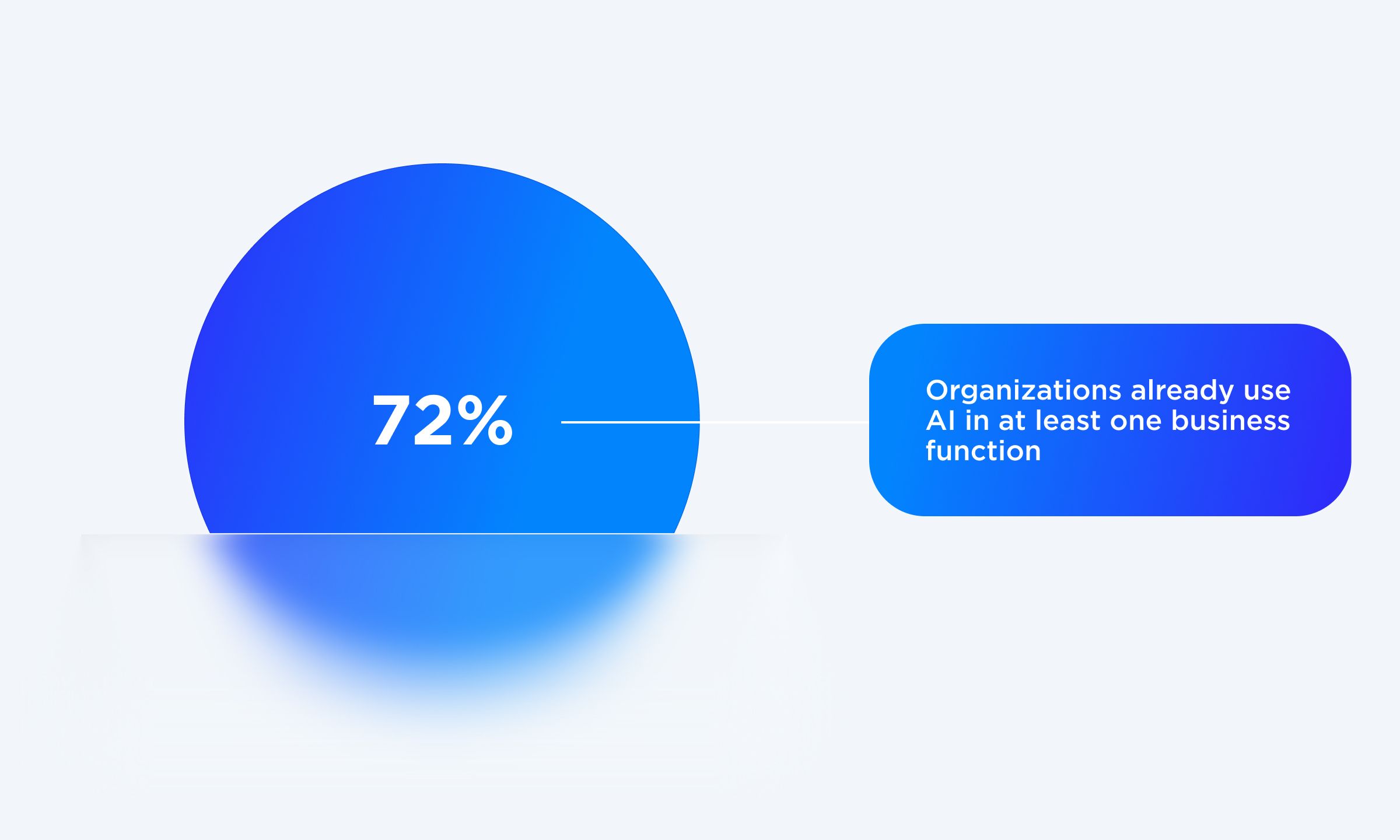
According to McKinsey, 72% of organizations were already using AI in at least one business function back in 2024, and about 65% said they regularly use generative AI specifically.
If you know how to use generative AI well, it becomes very hard to compete with you. The real-world Generative AI examples across industries below are proof of that.
1. Art and Design: Creativity Unleashed
Not all artists will agree with me, but Gen AI didn’t come to replace your designer. It came to give them back the Saturday they spent glued to their screen.
Tools like DaLL·E and Midjourney are the most well-known examples of Generative AI in creative work. Feed them a text prompt, get a visual direction in seconds. Runway ML takes it further into video, letting editors apply creative effects and generate footage that would have needed a full production setup.
What’s more interesting is the shift at the product level. Some platforms are putting editorial, engaging design within reach of product leads and founders who have never opened Illustrator in their lives. I'm talking about applications like Framer, Lovable, and Figma AI integrations. With a decent prompt and references, you can create brand visuals good enough to test and iterate on without a full design cycle.
If an MVP or a landing page for a new startup takes a designer weeks to complete, but with the neural network tools, they deliver the same quality result in two days, what would you rather pay?
I’ll never advise you to cut designers out, but to stop wasting their talent on repetitive, templated work. Gen AI gives space for creatives to think, explore, and bring something original to the table instead of losing their flow recreating the same layouts.2. Writing and Marketing: AI as a Co-Author
Anyone with basic online literacy can spot a ChatGPT-written blog post. You think you’re producing at scale. What you’re actually doing is slowly killing your brand’s credibility. Marketing is where you have to be the most careful with gen AI, and where it can do the most damage if used without oversight.
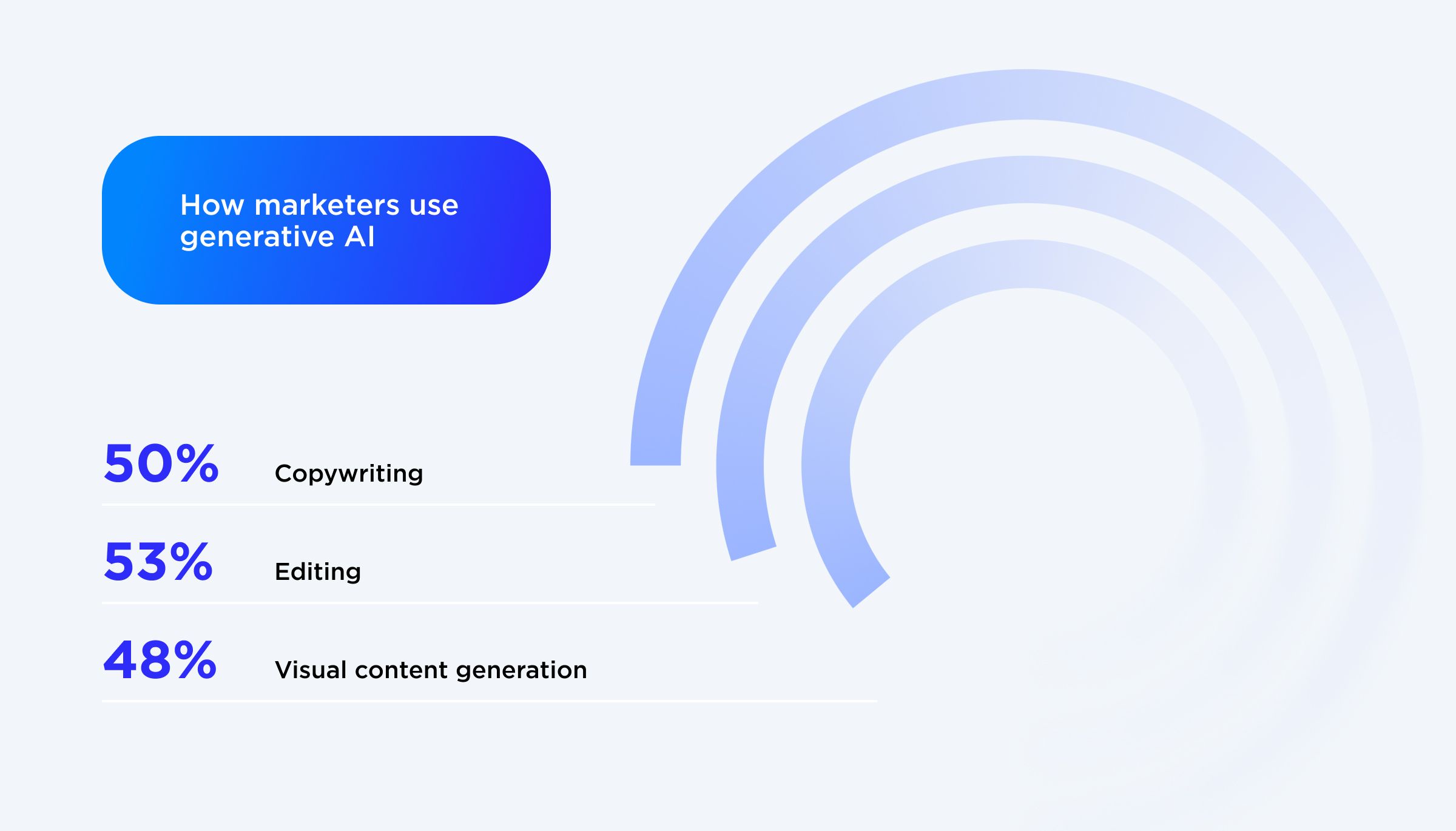
According to HubSpot’s State of AI report, 52% of marketers already use generative AI for text-based content creation. Among them, 50% use it for writing copy, 53% for editing, and 48% for generating visuals to support written content.
Large language models are not new. What changed is how people use them. Here’s how I’d approach it without a full marketing team behind me
- ChatGPT is great for brainstorming content strategy. Prompt it right, and suddenly you can stress-test your ideas from an audience perspective.
- Perplexity works well for market research and finding fresh angles worth writing about.
- Jasper and Copy.ai are built for marketing output specifically. Feed it your brand voice and get ad variations, email sequences, short form content for cold outreach, and socials without blank page fright.
Your content marketer is now managing a small team of AI agents that help them ship editorial calendars faster, run more experiments, focus on human tone, and free up headspace for decision-making.
3. Music and Entertainment: Composing the Future
GenAI models have been composing original music for a while. AIVE has been writing symphonies and film soundtracks since 2016. Sony’s Flow machines produced hybrid human-AI songs that actually charted. I won’t encourage you to try for a Grammy with an AI song, but that’s an example of Generative AI operating at a professional creative level.
Now, let’s look at those models from a practical perspective to see what businesses that are not in the entertainment industry can do with this.
If you’re scaling a B2C product, your Comms and Marketing team can now generate custom audio for ads, social videos, and brand content without waiting on a production house or coordinating freelancers (which always stretches the budget). Tools like AIVE handle background scores, and ElevenLabs covers voice synthesis, realistic narration in multiple languages, without a studio booking.
Let me connect the dots for you to show how it works for other verticals:
- Product demos and onboarding
Add a custom soundtrack or AI voiceover in multiple languages to make your product walkthroughs engaging and CLEAR, minimizing the mess of screen recordings and customer support inquiries. - PropTech
Pair generative audio with property rendering to create immersive virtual tours. - EdTech
Use AI video and audio to build gamified learning experiences or offer support for international markets. Hold the attention of much broader audiences. - B2C advertising at scale
Generate and test multiple audio-visual ad variations the same way you would A/B test copy.
The bottom line is that you don’t need a production budget to sound like you have one.

Explore how gen AI can make a measurable impact on your business.
CONTACT US4. Gaming and Virtual Worlds: Dynamic Storytelling
90% of game developers already use some form of AI technology in their workflows, and 97% believe generative AI is actively transforming the industry.
Game development is still an art form. Nobody wants AI to build the next Counter-Strike. But the industry found a smart use case for AI to handle the heavy lifting so developers can focus on what makes the games worth playing.
Tools like AI Dungeon and Ubisoft Ghostwriter use natural language processing to generate dialogues and storylines while you sip your coffee. Instead of scripting every possible branch, the model fills the gaps dynamically. NVIDIA Omniverse and Unity Muse use machine learning to build and enhance 3D environments, realistic lighting, textures, and worlds that would take a team months to produce manually.
Here is how I see Gen AI examples of real-world applications from a cross-industry perspective:
- B2C brands and SaaS products: A well-designed animated mascot or character powered by AI can make your onboarding feel like an experience rather than a tutorial.
- Real estate and architecture: In-app AI agents that, in seconds, generate realistic environment rendering and virtual tours.
- Fitness and mental health apps: Gamification mechanisms that adapt to user behavior, keep engagement up without rebuilding the experience from scratch.
Game studios are teaching us what real efficiency looks like. And the rest is just catching up.
5. Healthcare: From Drug Discovery to Diagnostics
Insilico Medicine uses AI to design new drug molecules by analyzing massive datasets of chemical structures and biological data. What used to take years of intense lab work now takes weeks of research. DeepMind’s AlphaFold cracked one of biology's hardest problems, predicting protein structures with accuracy that was considered impossible a decade ago. Both are real examples of Generative AI compressing timelines that used to be measured in decades.
I know it sounds like a lot of medical talk, but such achievements show how powerful AI agents can be when put to good use.
Beyond drug discovery, here is where we can spot a real difference:
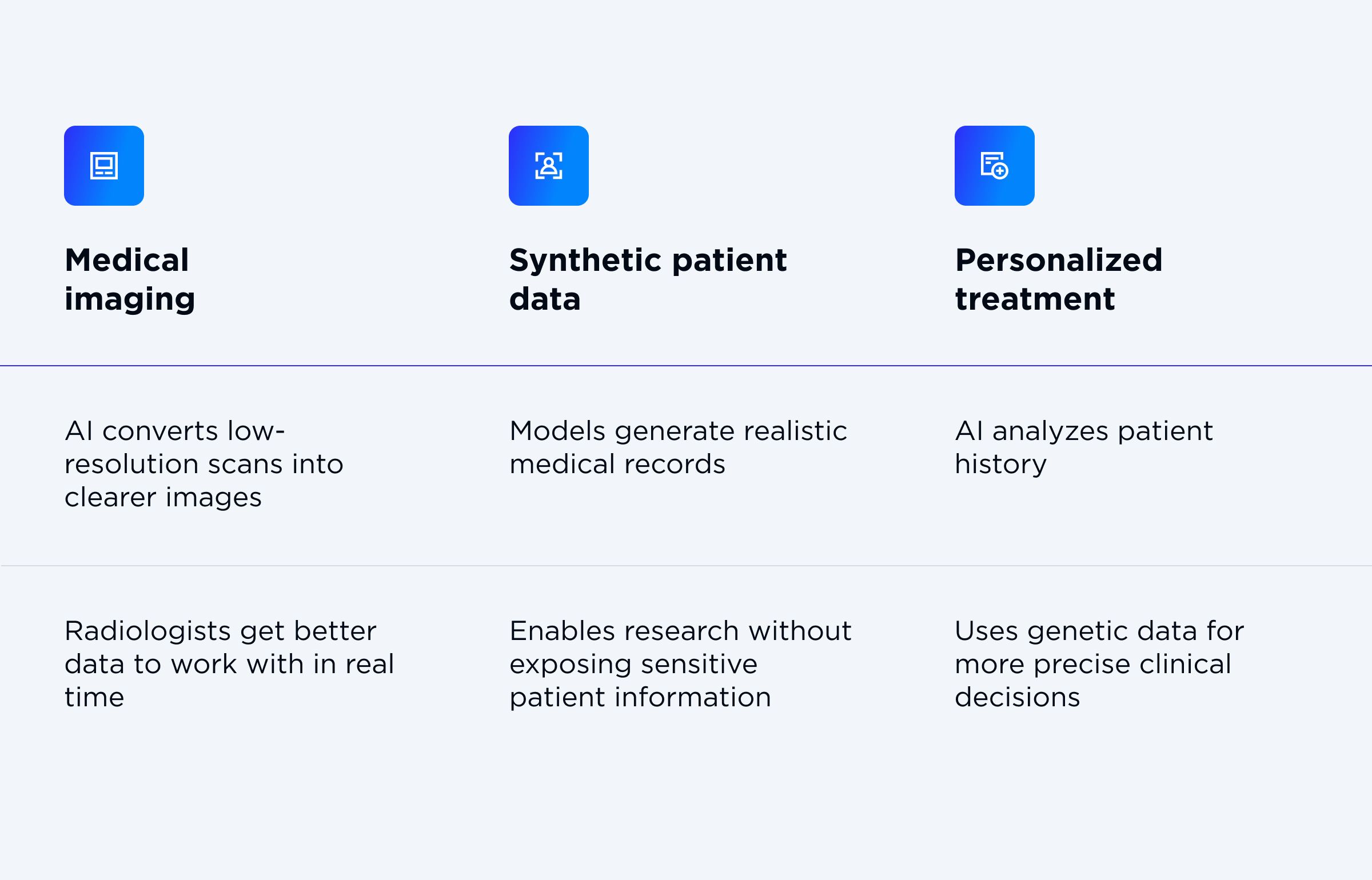
- Medical imaging: AI converts low-resolution scans into clearer images, giving radiologists better data to work with in real time.
- Synthetic patient data: Models generate realistic medical records for research without exposing sensitive information.
- Personalized treatment: AI analyzes patient history and genetic data to support more precise clinical decisions.
The common thread here is not outputs but data. GenAI gives clinicians and lab researchers sharper tools to make better calls that improve customer service and can drastically change the state of healthcare.
If you want to see this in practice, we built an AI-powered medical scribe that reduced clinical documentation time from 15 minutes to under 2 minutes per patient.

6. Fashion and Retail: Personalization at Scale
I wouldn’t paint myself as a fashion guy, but I stay on top of retail trends and couldn’t miss what Zara has been doing with AI. Their virtual try-on lets customers see how clothes look on a model that matches their body type in real time. Some would call it a gimmick. But can a gimmick cut online returns by over 10% and encourage full outfit purchases?
Stitch Fix takes a different angle. Their artificial intelligence analyzes customer style preferences, size history, and feedback to curate lookbooks for a human stylist to review and call the shots.
Based on McKinsey’s State of Fashion 2024, 62% of fashion executives reported using genAI, with 73% calling it a major business priority. The real impact is in personalization and operations:
- Intent-based recommendations: Models surface products based on customer behavior, not just purchase history.
- Supply chain optimization: Google Cloud, for example, helps retailers predict demand and manage inventory.
- Dynamic pricing: AI adjusts pricing based on demand and competitor data automatically.
The brands winning in retail right now are not selling excellent products. They're building experiences and connecting with the customer before they even click “add to cart”.

7. Film and Media: Reinventing Visual Storytelling
Hollywood is cautious. According to Deloitte’s 2025 TMT Predictions, major studios plan to put less than 3% of their production budgets into generative AI content creation, while shifting around 7% of operational spending into AI tools for dubbing, localization, and preproduction.
The gap tells you where the real value is. Generative AI cuts the parts of production that were never creative to begin with.
AI tools are not waiting on the IP liability debate:
- Runway Gen-2 generates video footage from text prompts using deep learning models instead of a full production crew.
- Synthesia builds an AI video avatar for corporate content, training, and localization without a studio rent budget.
- Lucasfilm’s ILM has been using gen AI to produce VFX at a scale and speed that traditional rendering pipelines simply can't match.
Honestly, the studios are not your benchmark here. If you are producing any kind of video content for your product, demos, onboarding, or localization, these tools are already within reach.
8. Coding and Product Development: Accelerating Innovation
Here is my honest take: GitHub Copilot and Vibe coding don’t give everyone a software development degree. If you see coding as hacking magic, you’ll only get enthusiastic prototypes with major security gaps and no database strategy, and that only hurts a business if you try to ship it to an App Store.
So it’s not a substitute for an engineering team, but it brings enormous value. 59% of developers save up to 4 hours weekly using AI coding assistants. That's half a working day for developers.
Here are some generative AI examples that make a real difference for software development teams:
| Use case | Tool |
| Code generation and debugging | GitHub Copilot, Cursor |
| Data science and analysis | GPT-4, Claude, Code Interpreter |
| Testing and QA automation | CodiumAI, Diffblue |
| DevOps and pipeline automation | Google Gemini Code Assist |
Don’t look at AI agents only as a tool to make your devs work faster. Your small engineering team can take on more complex projects, mentor more efficiently, and deliver features that were out of their scope before.
My Takeaway
Every example in this article points to businesses that stopped treating AI as a novelty and started building it into how they operate to see real results.
Conversational AI, learning models, code assistants, image generators. These and other tools are there, you just need the right strategy to use them. If you’re considering how it can fit your company, our OTAKOYI team is here to help!
As a CTO, I can jokingly call myself an HR for AI agents, but instead of hiring the best employee, I sit with you to figure out how to build one.